March 2019
Social Machines, or the Birth of a Machinist*
This is a project manifesto for the artist and the art critic.
"Machinist" is intended as a parallel to “humanist”.
As social animals, we humans interact within groups of individuals in ways that are not so different from those of simpler life forms. We have evolved to communicate for fundamentally cooperative purposes, using complex forms that have forged our cultures and societies. Now, these interactions have extended to machines as we develop devices that perform cooperative, complex tasks and engage in many aspects of our lives.
The study of animal behavior has demonstrated that the origins of our actions, as much as we would like to think they arise from free will, may be largely guided by emotions triggered by environmental stimuli. Fear, for example, is one of the most primitive emotions. It is so primitive that a neurological shortcut bypasses the visual cortex and routes sensory information directly to the amygdala, the brain region that governs fear, anxiety, and aggression. This means we feel fear even before we “see” the threat itself, much like primitive organisms without visual systems. The resulting emotional arousal triggers a cascade of hormones that increases heart rate, sweating, muscle tension, and other bodily effects—the well‑known “fight‑or‑flight” response. In modern societies, these reactions may be suppressed or transformed into subtler forms, but the neural feedback loops and physical effects remain. This physiological chain of reactions affects our decision‑making even when it is not obvious to us.
The Encyclopaedia Britannica defines the humanities as “those branches of knowledge that concern themselves with human beings and their culture or with analytic and critical methods of inquiry derived from an appreciation of human values and of the unique ability of the human spirit to express itself.” Literature and the arts, which we use to express ourselves, are at the very center of what makes us human. Some may argue that creative production is what distinguishes us from machines and other animals. Through evolutionary advantages, humans developed from single‑celled organisms with primitive adaptive behaviors into the art‑making creatures we are today; can machines evolve in the same way?
Ever since the rise of artificial intelligence, the fear of machine consciousness has shadowed the field. Some of our brightest minds have envisioned a gloomy future for AI. Theoretical physicist Professor Stephen Hawking warned in 2014 that AI “would take off on its own, and redesign itself at an ever‑increasing rate. Humans, who are limited by slow biological evolution, couldn’t compete, and would be superseded.” The idea that AI will eventually destroy humankind is a pessimistic projection that stems from our own nature to dominate others, gather resources, and reproduce. Will machines need and want the same things we do? If so, will some of them also develop “an appreciation of human values and of the unique ability of the human spirit to express itself”—or, in their case, machine values and spirit?
In recent years, machine‑learning applications have progressed to generate astoundingly creative works, some considered objectively good even by human standards. The future of machines’ creative potential is a question I would like to explore. Gaining a measure of human‑like personality would help a machine communicate with us more effectively as it performs tasks, especially if it is designed to serve as a companion. What will happen when machines begin to display “spontaneous” artistic expressions based on their own “emotions,” when their communication is so sophisticated and creative that it is mistaken for human? This project is a fictional and artistic inquiry into how “human” a machine can be.
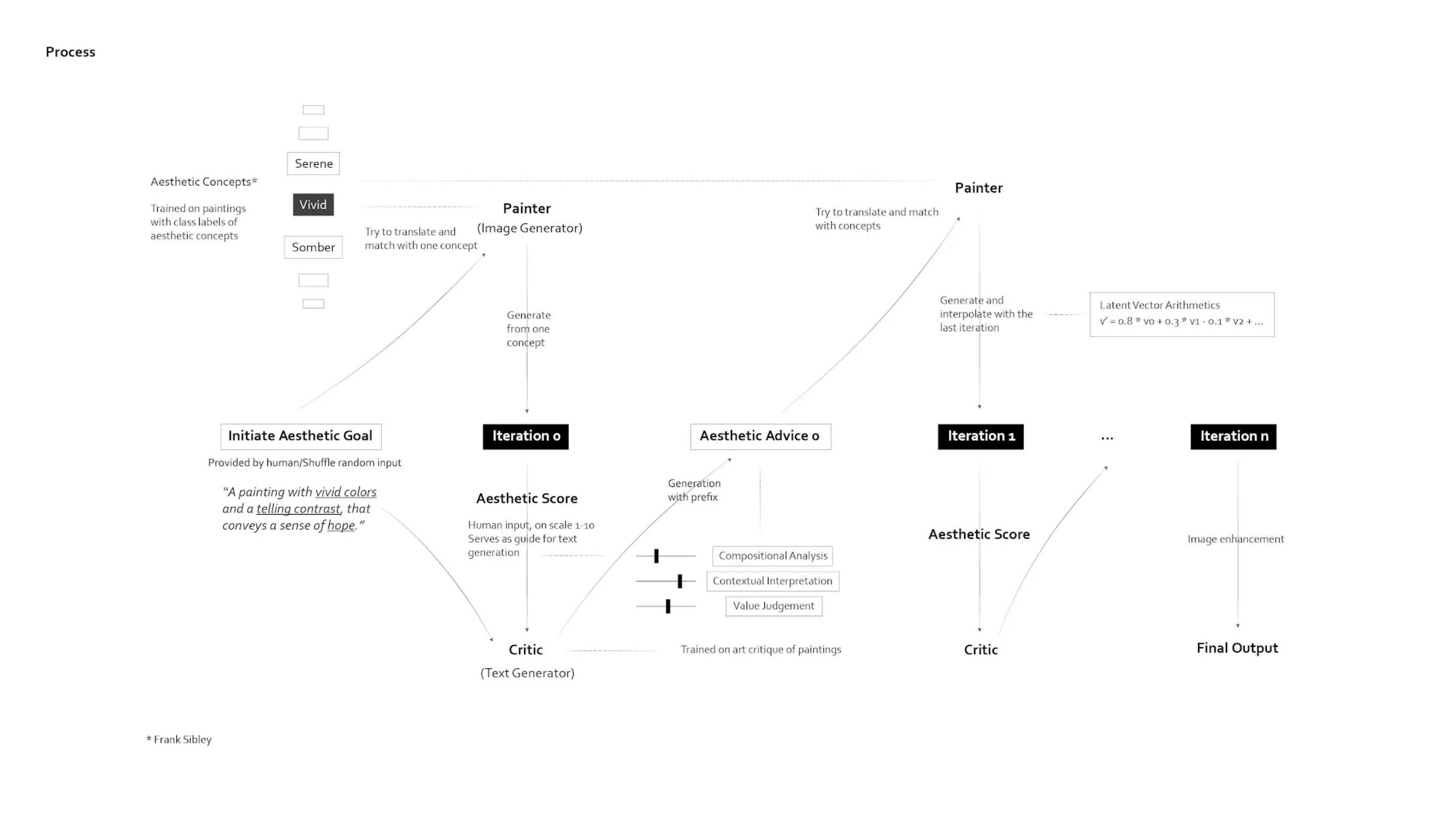
For the project, a “machine” will be a constructed system that resembles the neurological feedback loop of a living organism. It will consist of three parts: (1) environmental inputs—based on the machine’s “senses”—categorized into different types of emotional stimuli; (2) “emotional arousal,” which may vary according to the designed “personality” of each machine; and (3) “expressions,” which will take the form of generative artworks and fictions. The machines will assume various forms, merging with or growing into built environments and objects to communicate with humans. These interactions could occur in either a real physical space or a simulated one.
The project will employ machine‑learning tools to construct rich emotional content by training on existing artworks and literature. Sentiment analysis will serve as the bridge between input and output, guiding the system from categorization to generation. The rules of expression may also be designed and learned, ultimately making the procedures fully autonomous, though the methods require further study and experimentation.
This speculation is, on one hand, a well‑intentioned hypothesis about social, humanistic machines; on the other, it challenges our preconceptions about the boundary between human and machine. When machines begin to express emotions and become more “human” than humans, will we feel gentle affection for their friendly responses, or a sharp alarm that we may not be so special after all?