Reflex
Much of what we feel arrives before we have decided anything. Fear travels a shortcut that reaches the amygdala ahead of the visual cortex, so the body has already begun responding while the mind is still catching up, and the loop that follows — arousal, hormones, heart rate, the return of all that as sensation — runs largely beneath our notice. I wanted to build a place that sat inside a loop of that shape: an environment that reads what your body is doing and answers, so that the state you arrive in becomes the weather you find.
Gaze
Gaze is tracked with a Tobii eye tracker. Where you look disturbs the surface directly, the way a dropped stone would, so attention leaves an immediate physical trace. The gaze points are also held in a rolling buffer and examined for behaviour rather than position — whether you are scanning restlessly or holding still — and sustained attention on one place changes the light and the weather around you.
Motion
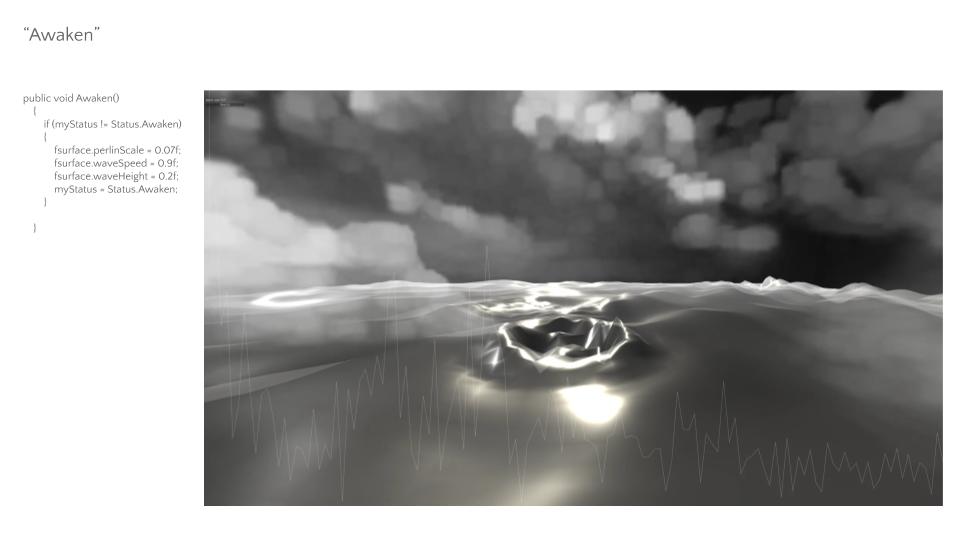
Motion comes from the accelerometer and gyroscope of a phone running a companion app, built in Unity alongside the environment itself. Rather than mapping movement straight onto the scene, I recorded it into a 256-sample buffer and ran a Fourier transform over it, which turns a stretch of movement into a frequency spectrum. The peaks in that spectrum, and how much they vary, describe the character of the motion — quick and agitated, or slow and even — and it is that character, rather than any single gesture, that the environment responds to. Reading the spectrum rather than the gesture is the point: a body doesn't register a single movement either, but the rhythm and intensity of many over time.
The environment
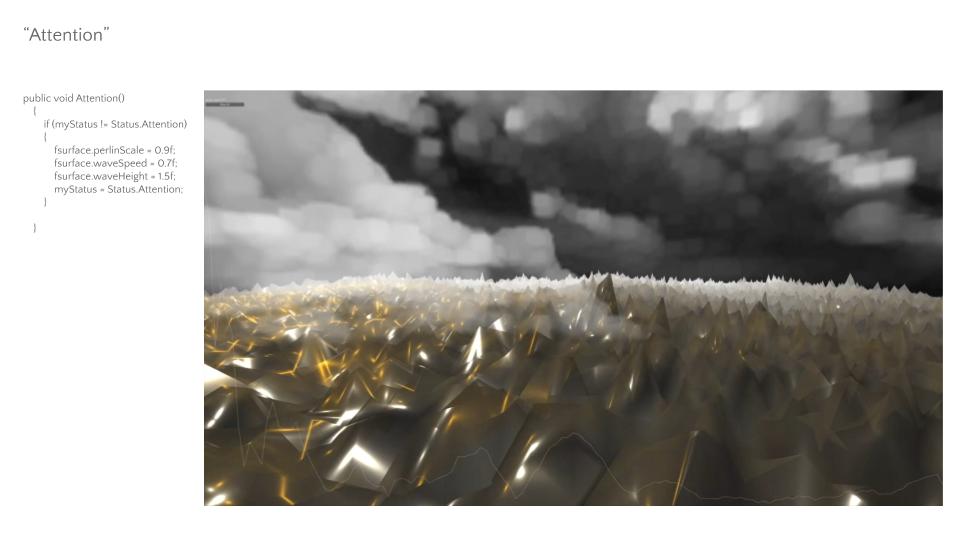
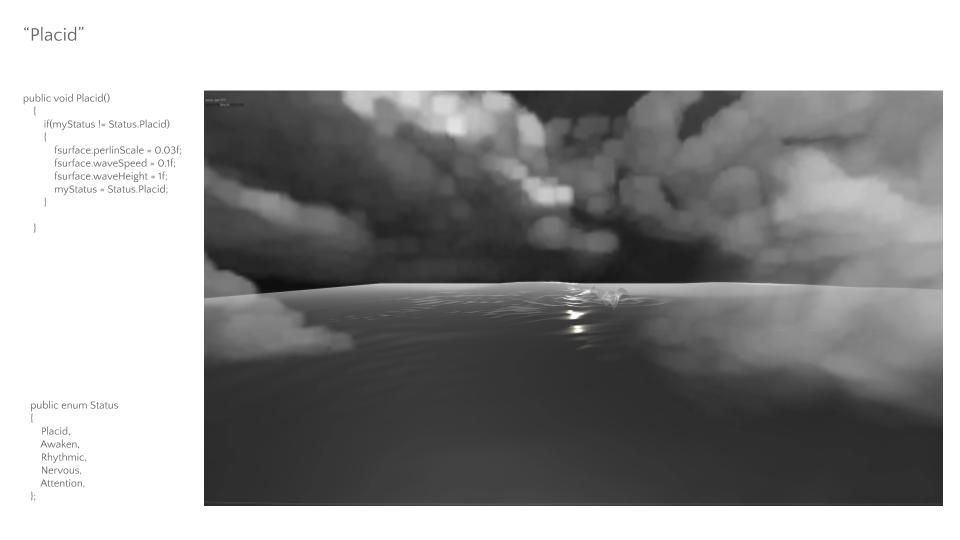
The landscape is a fluid simulation written in C#: a mesh whose vertices each carry their own velocity and displacement, with waves that propagate outward, damping and surface tension pulling everything back toward rest, and a slow Perlin drift so the water is never quite still. Fog scrolls above it and the light shifts with the weather. Nothing in the scene is a menu or a control; the only way to affect it is to look and to move.
Phases
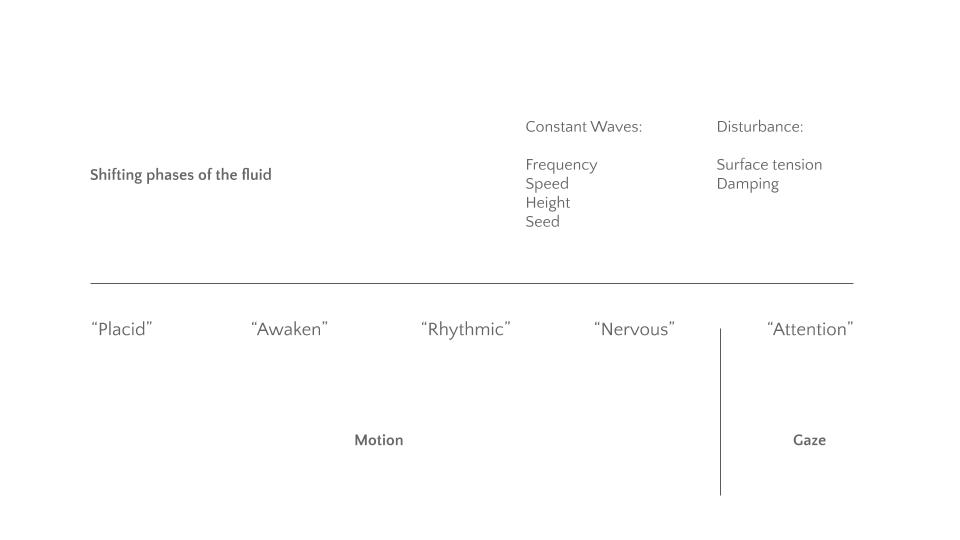
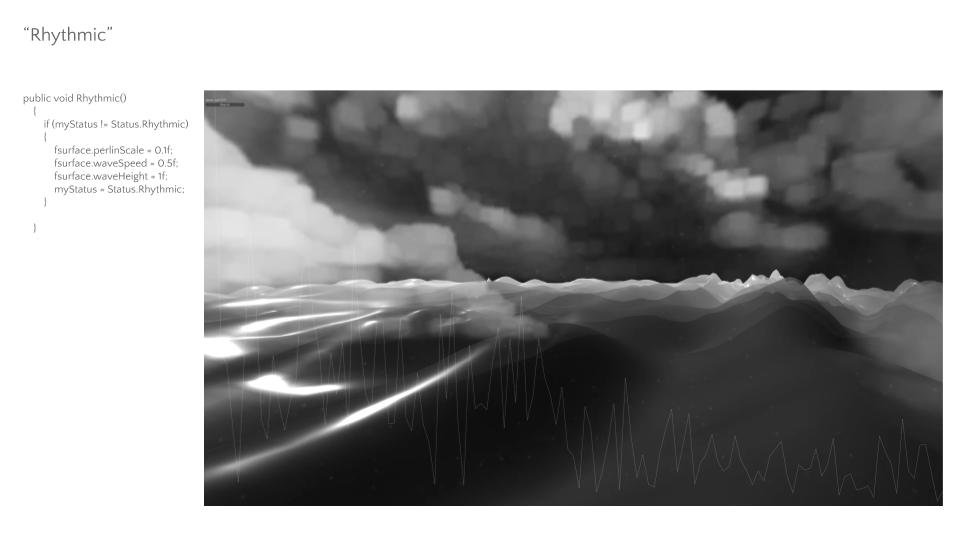
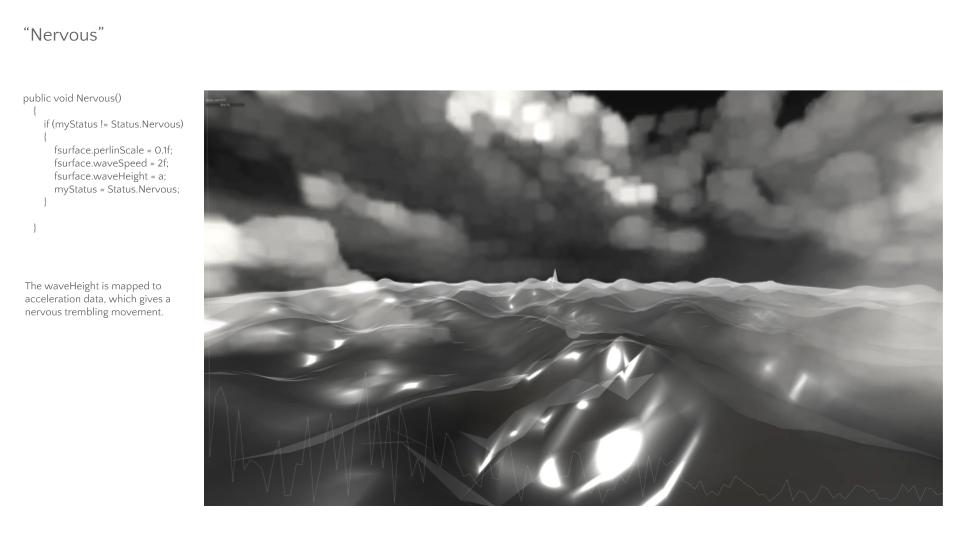
The environment holds five states — placid, awaken, rhythmic, nervous, and attention — each a set of values for wave frequency, speed and height, and for the surface tension and damping that decide how a disturbance settles. Motion moves it between the first four; sustained gaze brings on attention. No input maps to a single ripple. The readings decide which state the world is in, and the world behaves accordingly.
Future steps
The movements worth reading are the ones nobody chooses — subtle and involuntary, carrying state without conscious control. Detecting patterns in them rather than levels would let the atmosphere correspond to an inner state instead of approximating it. Further out the landscape forms from the input rather than being disturbed by it: terrain as the sedimentation of what a body has been feeling.